We welcome as members individuals and organisations who care for Hammersmith

As a Member, you will receive regular updates outlining our activities, giving you the opportunity to participate in consultations and campaigns. We'll invite you to our Awards Evening and AGM, and other events. Members are always encouraged to take an active part in the work done by the committee – come along and see if you can help.
The membership year runs from 1st Jan, and only costs £6 for individuals, £8 for couples or families, and £15 for organisations. Additional voluntary donations always welcome.
 Join Here
- Published: 27 Apr 2024

Royal Masonic Hospital Block A, as proposed
We’ve reported on progress of this substantial development three times over the last two years; the plans are now complete and public, with 385 documents under planning reference 2023/03129/FUL. We’ve been in regular contact with the developers and attended meetings, as have the immediately neighbouring residents, and groups including Residents Associations either side – Ravenscourt Square – and our affiliate in Ravenscourt Gardens RA. These public consultations are summarised in the proposal’s Statement of Community Engagement on the planning portal.
We’ve said publicly many times that rescuing and repurposing this Grade II* set of hospital buildings is most welcome, but as usual, not at any cost. We review the proposal in that mindset. On the plus side, it’s a relatively sensitive proposal without the usual gross overbuilding we see in almost every other development. The team has engaged widely and openly with interested community groups, and many of our concerns have been considered and several addressed in the plans now proposed.
We welcome the refurbishment of this precious building, and appreciate the care that has been taken in the design of the alterations necessary for the new residential use; however we still have some significant concerns, most of which have been expressed in previous updates and are summarised as follows:
- In conservation terms, there remain significant concerns over the inappropriate glass podiums over Block A as pictured above. These have been tamed and improved since originally proposed, but there’s no getting away from the fact that there’s no actual use proposed for Block A, other than as an entrance, so these are strictly unnecessary additions without a clear public benefit. The NPPF sets the criteria for such interventions on such listed buildings, as we, Friends of Ravenscourt Park and the Historic Buildings Group have said before, this remains unaddressed. The Design and Access Statement uses an inappropriate combination of the council’s industrial strategy and an apparent inability to subdivide the heritage rooms as reasoning for their creation.
-
Continued
- Published: 06 Sep 2023

H&F wheelie bins
Members have been writing to us about council plans for wheelie bins in some areas, though parts of the borough already have them from a pilot scheme. Our interest is to ensure that they don’t damage the streetscape and the wider environment through excessive or unnecessary deployment of plastic, especially of the large and/or dayglo variety.
The council circulated leaflets to 16,000 households in the borough announcing more wheelie bins and food waste containers. To date, there has been no suggestion of a public consultation process with residents before deployment, which hardly matches the philosophy of ‘Doing things with residents, not to them‘ listed against every council policy. There is a possible opportunity to reject them, but only after the fact, through an unpublished ‘reassessment’ process. Out would go your dustbins (if you have them) and in would come tall and bulky plastic bins – one for waste and one for recycling. You would also be given a smaller food waste container.
To take the food waste first – for the majority who do not have a compost bin, this container may be helpful. It would remove food from black bags and so reduce ripping and spillage. It can be locked to prevent animal access and the waste will be processed to make fertiliser. So far, so good.
The large bins are another matter. Not only are they much taller than a regular dustbin at about 1.1m, and therefore much more obtrusive above a wall or fence, they are also bulky and take room in a front garden. For residents who pride themselves on an attractive and green garden this will come as a blow. Where are the bins to go? Who is to pay for the necessary re-paving?
As the bins have to be wheeled out to be emptied their access has to be clear – no shielding them behind shrubbery. If you normally do not have a bin you would be required to have two. Bins would be the first thing that greets you and your visitors, and the ‘kerb appeal’ of your home and the whole street could be significantly harmed as the photos below show, reducing amenity, social and financial values, to the detriment of all – aside from an unspecified figure on the council’s bottom line.
Bin sizes

World’s fastest wheelie bin- 88km/h
The standard 240L dayglo green recycling bin is the largest size commonly available, and three – yes three – times the size of the a conventional 80L bin, which is about half the height, and one-sixth of the weight – empty. It can hold five bin bags, or the weight of a large grown man, as many a comedy sketch – or recent world speed record – confirms. The black ‘waste’ bin at 140L is nearly twice the size of a conventional bin. This represents an aggregate of just about five times the bin storage space you probably have now, and in a world increasingly short of space, and trying to reduce waste of all sorts, appears to send a very odd message.
Continued
- Published: 12 Jun 2023

RMH Block A – May 2023 proposal
Ideas for the development of the Ravenscourt Park Hospital campus are beginning to emerge from the new owners Telereal Trillium with their architects SPPARC Studio. There’s an interesting ‘information pack’ with historic photos and maps on their project website; here we include the key views from the May 2023 exhibition boards.
We’ve also seen detailed comments from the two adjoining Residents Associations – Ravenscourt Gardens and Ravenscourt Square – who both have significant concerns about adjacency and the effect of access requirements for a substantial housing development on their doorsteps. These have been submitted to the council, and while noting them, here we look more at the effect the proposals would have on the Grade II* listed building and its setting.
As proposed, the development would harm the buildings it’s supposed to improve.
The scheme proposes that the 1930’s hospital buildings would be enlarged by adding two, three or four upper floors, generally set back from the building edge, and faced with saw-tooth profile glazed curtain wall shown in the CGI’s above. The roof extensions would be limited to one level on the outer blocks of the principal building “Block A” facing Ravenscourt Park, which would be refurbished and converted for a community use yet to be defined; the remaining buildings would be refurbished and converted to residential use. We would welcome an open and inclusive process of co-design to evaluate possible future uses of Block A, to arrive at a defined and sustainable use that works for the community and developer.
The 1978 surgical and ancillary building on the northwest corner, beside Ravenscourt Square, is proposed to to be replaced by a residential block and a separate care-home block, shown as undefined white blocks “E” and “F” in the model above.
The hospital building is a stand-alone architectural whole, a form which does not readily invite extension. It employs a restrained, consistent architectural language, with regular geometric brick forms, orderly window perforations, playful articulation separating the building elements with circular balconies and pavilions, and a bold, heroic principal block facing the park. These unique qualities would be overwhelmed by the changes proposed. The roof extensions would impose an architectural levelling-up, bringing an inappropriate sameness to the distinctly separate elements of the buildings. The eye-catching angular glazing design would be at odds with the quiet regularity of the buildings below, and would hardly reflect the visual subservience required in planning policy.

RMH Blocks E & F as proposed May 2023
The new buildings proposed for the northwest corner “E” & “F” are shown only in diagram form on the display board image adjacent, and further design information is needed, including contextual views showing the relationship of the new blocks to the hospital buildings, the overall campus, and the neighbouring buildings of Ravenscourt Square – especially Grade ll No. 11, and locally listed No. 17 on the corner.
There is also proposed access East-West through the site, between blocks “D” and “E”, which is not currently possible, and it’s fair the say that there are mixed views about this proposed feature in the adjoining communities.
The NPPF (National Planning Policy Framework) sets out the relevant policies for listed buildings, and requires that alterations proposed to heritage assets are assessed by Historic England according to the extent of harm they would cause, and states that ‘…substantial harm to a grade ll* listed building should be wholly exceptional’ (NPPF para 200). Some concessions may be allowed where the changes would support the future conservation of the building, or would bring about significant public benefit.
These criteria rule out the current proposals: the extensions would bring very substantial harm to this wonderful building. While they could generate funds for the conservation of the building and gardens, the accommodation they provide would bring no benefit to the public.
Conclusion
The early opportunity for public involvement is welcome, and we have carefully reviewed the May 2023 proposals, and set out our response above, together with a letter containing the same points to the council planners.
Continued
- Published: 24 May 2023

The Origin and Possible Future of Hammersmith & West London College by Hans Haenlein
Click on the image to open the pdf 
Under the banner ‘Taking a View’, from time to time, we’re pleased to publish articles by members on a subject of their choice, which they believe will be interesting to the wider membership.
In this article, our president, Professor Hans Haenlein, updates us on an issue close to his heart: Hammersmith & West London College, both from an architectural but as importantly, a topical Further Education point of view, tracing its origins back to the Arts & Crafts movement and William Morris.
If you have an article you would like to be considered, please contact .
Articles are unedited personal viewpoints, and may not always represent the views of the Society
- Published: 30 Mar 2023
In the last week there have been well-publicised consultation meetings either side of the river, covering the repair and refurbishment of the bridge together with proposed Foster/COWI temporary bridge. Below are photos of the models of the proposals, but there’s one further public exhibition in Barnes this Saturday – details in the diary
We’re delighted to see that the designers have adopted our 2020 proposal to widen the pathways alongside the bridge to at least 2.3m, to better facilitate walking and cycling which are currently rather less than ideal. One of the photos below shows before & after views, and you can see that the visual impact is minimal [click on the images for larger versions]. We understand that Historic England are satisfied that this won’t harm the setting of the Grade 2* bridge.


There’s a further piece of thinking to complete the necessary crossing of both 2-way cycling and pedestrians. Crossings naturally exist under the bridge at each side as we recall from the heights of COVID, but there remains a risk of paths crossing awkwardly. Subject to agreements, there may be an opportunity for the temporary walkway pictured to be part-repurposed into better crossover(s) after completion, with perhaps a smaller scale nod to the recent Dukes Meadows Footbridge.
Continued
- Published: 13 Feb 2023


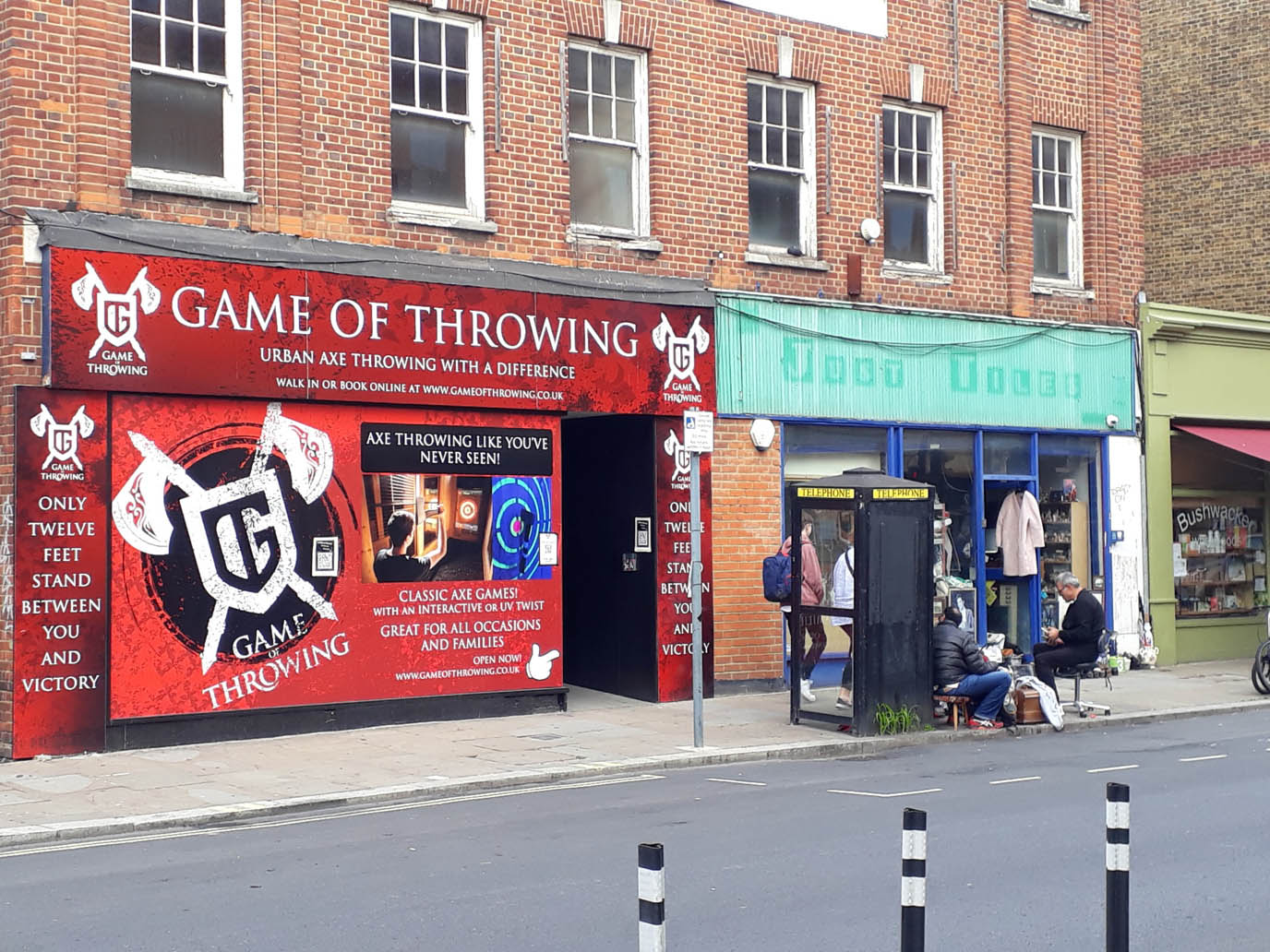
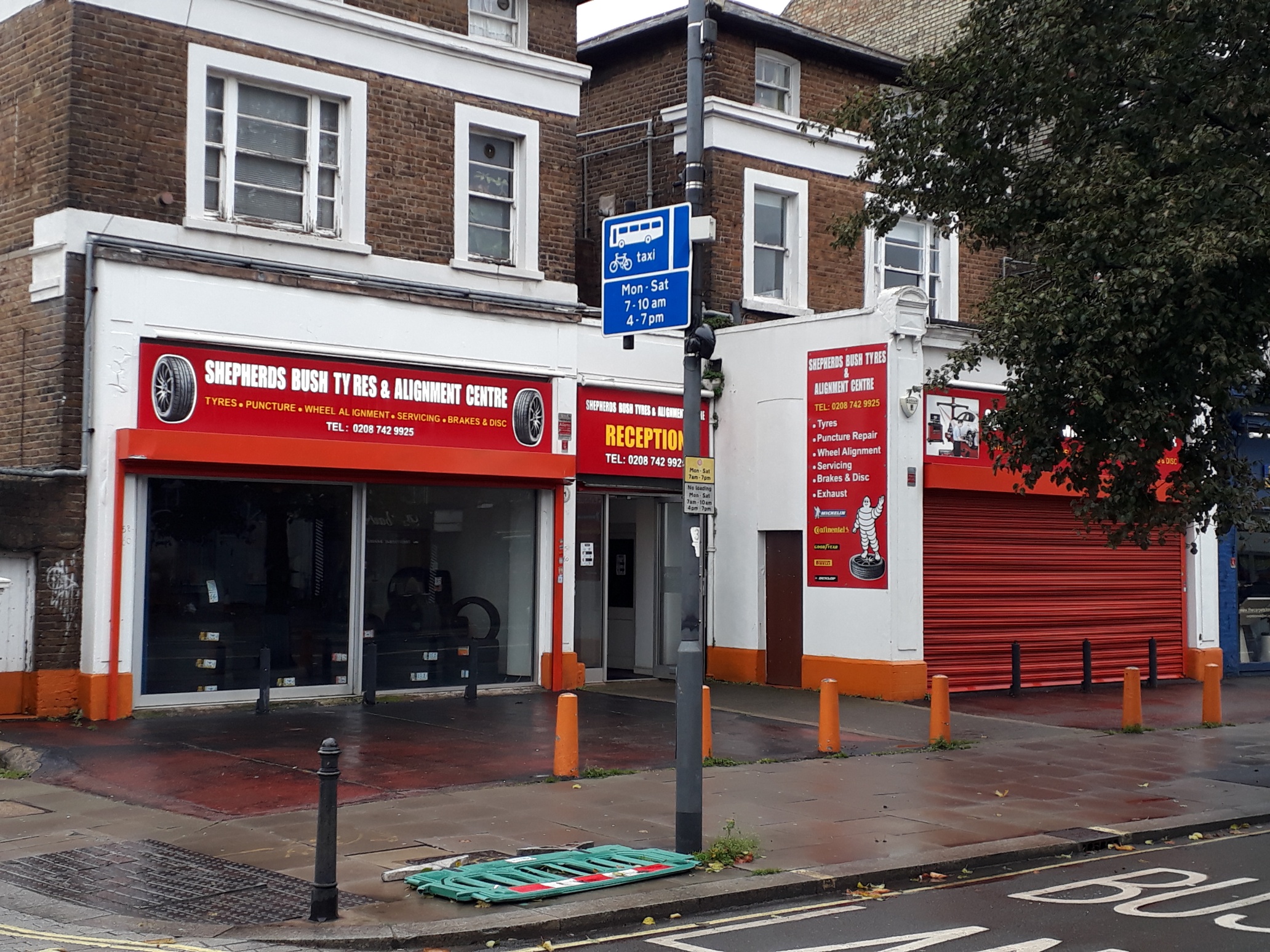
In recent months we, our members, affiliates and others have noticed an increase in unsympathetic shop fronts or public realm land-grabs adjacent to shops, particularly in King Street, but elsewhere in the borough too. We are of course aware of the plight of the high street, an issue we wrote about in 2019, but the pandemic seems to have accelerated a slip in standards. The pictures also demonstrate an unfortunate correlation between these slippages, metal roller shutters (with or without graffiti), and some of the better historic buildings, sharpening the discordancy. Shopfronts require the same constraints as rear extensions – ‘subservient to the existing building’. A strong building presence at ground level – with visible walls between the shop openings – can accommodate a variety of shopfront designs without losing the integrity of the building design.
Some larger chains are showing is that it’s quite possible to build new frontages sympathetically, while maintaining enough corporate branding to meet the business needs, though it’s unclear how much cajoling the various local authorities undertook to achieve these results. Unfortunately we’re not seeing quite enough of this in parts of Hammersmith – yet.


Paintbox Studios and Coffeeology: Nancye Goulden Award 2019
Longstanding members will recall the Nancye Goulden award we gave to the Nicholas Mee showroom in 2013, a “stylish minimalist modern frontage”, which appeared to be a high point, with the nearby Ginger Pig also awarded in the same year. In 2019, helping to highlight what can be done in our high streets, we awarded the two adjacent shops shown at the western end of King Street, but the eastern end remains a rather different matter.

Nancye Goulden Award 2013 – The Ginger Pig

Nancye Goulden Award 2013 – Nicholas Mee Aston Martin showroom
A few years after the award, Nicholas Mee sold up, possibly feeling – correctly as it turned out – the zeitgeist turning significantly against car ownership in general, big-engined luxury car ownership in particular, notwithstanding the skilled jobs involved. The workshop in Wellesley Avenue was also sold, leaving a site that’s been fought over tooth-and-nail since. These days, the mere suggestion of a car-related enterprise locally may have segments of the population foaming at the mouth, though the residents of Wellesley Avenue probably still reflect fondly on the glamorous metal formerly adorning their neighbourhood. We digress.
Continued
- Published: 15 Nov 2022

RMH isometric from https://www.ravenscourtparkhospital.info
Earlier this month we met with the new owners of RMH, Telereal Trillium, their planning consultants, Turley, and Trevor Morriss of SSPARC architects appointed for the redevelopment, who you may remember giving a presentation on the Olympia redevelopment at our AGM in 2019.
They gave us a rundown of Telereal Trillium’s background (mainly a large portfolio of former public sector property, a large proportion of which were in the BT and DWP estates, formerly owned by Land Securities). This is not their first listed building redevelopment – the example they gave us was the one on the website, the Grade II listed Tooting Police Station. As it’s early days, there were no more details available other than that on the website boards, shown above and on their website.
Telereal Trillium describe themselves as an £8 billion family owned property development company owned by the William Pears Group. They say that they are not “operators”, they have moved from being owners to owner/developers recently, and are not currently planning on going further into running buildings.

RMH block plan view
The 80’s block at the back of the site shown in pink adjacent, “Block E”, was suggested as the location for the main redevelopment activities, the rest of the estate is more a case of preserve, enhance and convert into luxury accommodation, with restoration of the surrounding gardens, which is good news.
Discussions with the council started in June, but there have been no formal planning pre-application meetings yet. We mentioned that we’re extremely keen to engage early, offering our experience and local knowledge on behalf of the wider community. Meanwhile we’re looking at how National (NPPF), London-wide (London Plan), and borough (Local plan) guidance applies to this project.
The large public spaces in the listed parts of the estate (“Block A”) are where the community use and engagement is critically important. We discussed possible educational and other uses, but only in outline at this initial stage.
We’re pleased that this important building has an engaged new owner, and look forward to its unique interiors being open for public enjoyment again in an appropriate form. Your suggestions for suitable uses are most welcome.
- Published: 15 Nov 2022
New Civil Engineer recently reported that the bridge stabilisation has progressed and that specialist concrete has been poured into the cast iron pedestals to prevent them collapsing. This means that the bridge is safer for the next stage of repair, which we mentioned in the last email. The stabilisation works are scheduled to complete by the end of February 2023.
It’s worth mentioning again that while the funding arrangement for the rebuilding has been determined, actual funds remain scarce, and the long term funding and maintenance model is undecided. The council prefers to package it up so it can be put into a trust and managed at arms length.
The next step is diversion of a gas main at a cost of £5m, and the letting of contracts so that works on the actual major repairs can begin. We have requested copy of the £200k feasibility report into the Foster/COWI temporary bridge to better understand details of the proposals.
There’s been some press and politics around a proposed bridge toll as a way to close the gap in funding for the rebuild, and whether or not residents would be expected to pay. A historic problem with tolls has been that it cost a significant percentage of the actual toll to collect, and with so much cash sloshing around, there was often significant fraud. Newer technology, such as Automatic Number Plate Recognition (ANPR) would presumably lessen these overheads, if not the displeasure.
We are grateful to the Barnes Bugle for alerting us to a detailed video from Mott’s explaining the whole process for those interested in the technicalities:
Continued
- Published: 26 Oct 2022

King Street – M&S proposed frontage elevation
Many of you will have been to the exhibition at the Lyric recently to view the proposals and displays. We exhorted the development team to show full elevations, but the best we achieved at the time were partial CGI images. They have now come forward with North and East elevations, which are on the consultation website, along with the exhibition boards, and above / below, and appear to be part of a pending planning application. The large towers in the background are the proposed Landmark House, as yet unbuilt, and we believe subject to change of ownership, and therefore possibly design change too.
As you can see, our very approximate CGI in the earlier article was reasonably accurate dimensionally, if not aesthetically, and at 47m, this undistinguished proposal is of alien scale, substantially higher than the Lyric, and a large intrusion on the King St. horizon. The 15m setback from the street helps reduce this intrusion only marginally, which you can see below.

King Street – M&S elevation, East
More importantly, acceptance at this dimension would set a bulk and height precedent along King St., much as we’ve recently seen used in the 66 Hammersmith Road proposal, especially in the continuing absence of an issued Town Centre Masterplan, or planning brief, a subject on which we repeatedly remind the council is nearly 5 years overdue. We haven’t even mentioned a likely West-East prevailing wind tunnel, increased if others were to follow suit.
Continued
- Published: 26 Oct 2022

Black Bull Tavern 122a Holborn, 1901 [pubwiki.co.uk]
The Black Bull was modelled in the early 19th century by Obadiah Pulham from Pulham & Son. In Victorian times, this was a well-known Suffolk-based firm specialising in the production of garden ornamentation for prestigious sites across the country and the material used would have been ‘Pulhamite”, a particular blend of artificial stone they had devised.
Brought into London by Thames barge, the bull’s destination was to serve as the sign for the Black Bull coaching inn at 122a Holborn, an establishment mentioned by Dickens in Martin Chuzzlewit. He adorned the front of that building until 1904 (seen below the second floor window alongside the Black Bull nameplate), when the old inn was demolished to make way for a corner extension to the original Gamages department store.

Black Bull transitioning to Gamages, 1904, [pubwiki.co.uk]
Reporting this event with some regret as the loss of a favourite destination for American tourists, the New York Times wrote on May 20, 1904: … “the old Black Bull of Holborn was lowered from his perch yesterday, and his retirement from public life marked the demolition of the famous old London inn that bore his name”.

Sir William Bull MP’s offices at 269 King St, bull over entrance [H&F Archives]
But saved from destruction by the Hammersmith MP Sir William Bull, our bull was transported over to King Street and relocated above the entrance of the Georgian terraced offices of the MP’s law firm, then at number 269. There he stood for over half a century until those buildings too were demolished.
Rescued again, he was brought down to earth to be unsuitably positioned head-on, on a plinth in the forecourt of an undistinguished ‘estate-style’ pub called the Ravenscourt Arms, later renamed the Black Bull, built in 1966 on the site next to Vencourt House, now a Premier Inn, at 257 King Street. In recent years, that pub too closed, leaving the Black Bull of Holborn stranded in the tumbleweed, and once more seeking a suitable Hammersmith home.
The Ravenscourt Arms was owned by Charrington, its successor the Black Bull was part of Punch Taverns, but according to the council, current ownership looks to be connected to the hotel adjacent. Do you know any more? We, alongside Heritage of London Trust, would like to have him restored, and found a more appropriate home.

The Black Bull in King St. 2022

News Topics
Our Diary
-
Committee meeting
📆 Mon 14th Sep | 19:00 - 21:00
-
2026 AGM and Awards Evening
📆 Tue 13th Oct | 18:30 - 20:30
🚩 The Sulgrave Club, 287 Goldhawk Road, W12 8EU (map)
Recent News

The area outside Greenside school has been transformed with a landscaping scheme funded by the Council’s Green Investment scheme. The pupils at …


Local and Affiliate News
One news item from each selected source – more on our Local and Affiliate news page. Subscribe to our weekly highlights
- OPDC Planning Committee: Thursday 10 September 2026 6.00 pm Read more »
- This consultation exercise was due to conclude on September 8th 2026, but has taken an unexpected turn. At its open meeting on… Read more »
 Large household items can be disposed of for free across the borough Read more »
 The Heritage Fund worked with Historic England to better understand how the climate crisis is affecting the UK’s natural heritage sites and… Read more »
- The disturbingly hot summer, with its concocted media furore about “vertical drinking” and its heroic claims about late night alcohol consumption being… Read more »
 Carolina Camara supporting indigenous women in Mexico Read more »
 Restoration works means trains not stopping later this month Read more »
- Cabinet: Monday, 14th September, 2026 7.00 pm Read more »
- With the summer holidays nearly over, it’s time to start getting ready for the new school year. We’ve put together a list… Read more »
- Shepherds Bush Railway Bridge Gets a MakeoverIn another small victory for the Campaign To Fix Uxbridge Rd, the Shepherds Bush Railway Bridge has been… Read more »
 It’s that time of year again! Our AGM is your chance to hear how the association has got on over the past… Read more »
- We have warned that the government’s ‘pro-growth’ planning agenda comes at the expense of social and environmental benefits. We believe that the government’s decisions on the… Read more »
 What would you say if you were told that a 22-acre brownfield site in London’s zone 3, well connected to overground, underground… Read more »
- The Trustees met on 15 June 2026. Minutes of the meeting may be downloaded here. Here is the report on the WSCT… Read more »

Most Popular Articles This Week


 ©2026, The Hammersmith Society | Privacy | Contact | Join | @ Subscribe | ⓘ
Campaigning for over sixty years