We welcome as members individuals and organisations who care for Hammersmith

As a Member, you will receive regular updates outlining our activities, giving you the opportunity to participate in consultations and campaigns. We'll invite you to our Awards Evening and AGM, and other events. Members are always encouraged to take an active part in the work done by the committee – come along and see if you can help.
The membership year runs from 1st Jan, and only costs £6 for individuals, £8 for couples or families, and £15 for organisations. Additional voluntary donations always welcome.
 Join Here
- Published: 15th February 2026


(AGM Photos: Anne Farthing. Click for larger versions)
We were delighted to announce our 2025 Awards at the delayed AGM at the recital hall in Latymer Upper School on Monday 9th February. We were equally pleased to see a large number of members, and that both our MP’s felt able to tear themselves away from Westminster turmoil to join us. The awards were introduced by vice-chairman Richard Winterton and kindly presented by the Mayor of Hammersmith and Fulham, Cllr. Sharon Holder.
After his three-year term, Richard Farthing stepped down as chairman, and Angela Clarke MBE was elected, along with several new committee members. AGM photos, more information and the administrative documents are posted on the 2025 AGM page. Award details and the associated narrative are posted on our 2025 Awards page together with a link to the updated spreadsheet of all awards since 1990, and matching interactive Awards map.
Awards summary

Award winners 2025
Making up for last year’s dearth of Environment Award nominations, this year we had two excellent nominations, and both worthy winners of our top award: the New Timber Yard off King St., and MacFarlane Place on Wood Lane.
In the smaller project catagory for our Nancye Goulden Award, we’ve seen a number of nominations and winners for Streetscape improvements in recent years. This year it was the turn of the new rain gardens in King Street, partly paid for by the council’s Green Investment Fund, and installed by the Hammersmith Community Gardens Association. We were particularly pleased to see natural materials replacing the ugly asphalt in the tree pits adjacent, something we’ve long campaigned for, and indeed awarded wooden spoons to the council for, in four of the last twelve years.
There were two Wooden Spoon nominations this year, for the generally dilapidated condition of Uxbridge Road, and the inappropriate redevelopment of The Hampsire Hog, to become The Hammersmith Belle. The committee felt that there was an insufficiently clear target for the many issues in Uxbridge road, but that failing to react to the recent proposals of the ‘Fix the Uxbridge Road’ campaign group, could result in a wooden spoon for the council next year. The Hammersmith Belle was a popular ‘winner’ however. Further details and photos are on the 2025 awards page.
Continued
- Published: 20th January 2026
Our member Edward Rose has thoroughly researched the Black Bull, which we wrote about in 2022, and has now written the 180-page self-published book pictured, which he’s offering to members.
Since we wrote the original article, we’ve been working with Heritage of London Trust to try to find a suitable new home, and arrange for it to be restored, in a similar way to the Greek Runner and Leaning Woman. We’ve been jointly investigating the somewhat opaque ownership of this Grade II listed figure as a precursor, work which continues.
If you would like a copy of the book, please contact Edward using the form below.
- Published: 26th August 2025

Lawn House CGI
Lawn House stands on the corner of The Lawn and Uxbridge Road, next to 2023’s award-winning Hoxton Hotel, partly shown. Previously a Barclays Bank and now vacant, it provides the opportunity to complete The Lawn’s decade-long transformation into a series of hotels with improved public realm. This hotel is proposed to contain 130 rooms, 60% with kitchenettes.
A significant feature of the public realm are the arches of the proposed building’s frontage, said to echo the railway arches nearby, alongside the 2017 conservation award-winning Bush Theatre. These could divide opinion, perhaps considered as sitting uncomfortably with the uniform warehouse chic of the Hoxton adjacent, or acting as a pastiche of the Dorsett’s heroic arches and roofline – let us know your views. For reference, below is a photo of the existing building, showing the adjacent part of the Hoxton with its awnings.
The design has considered the adjacency and daylight/sunlight issues with residents in Pennard Road directly behind, and the developers, Lamington Group, have been in discussion with them for some time.
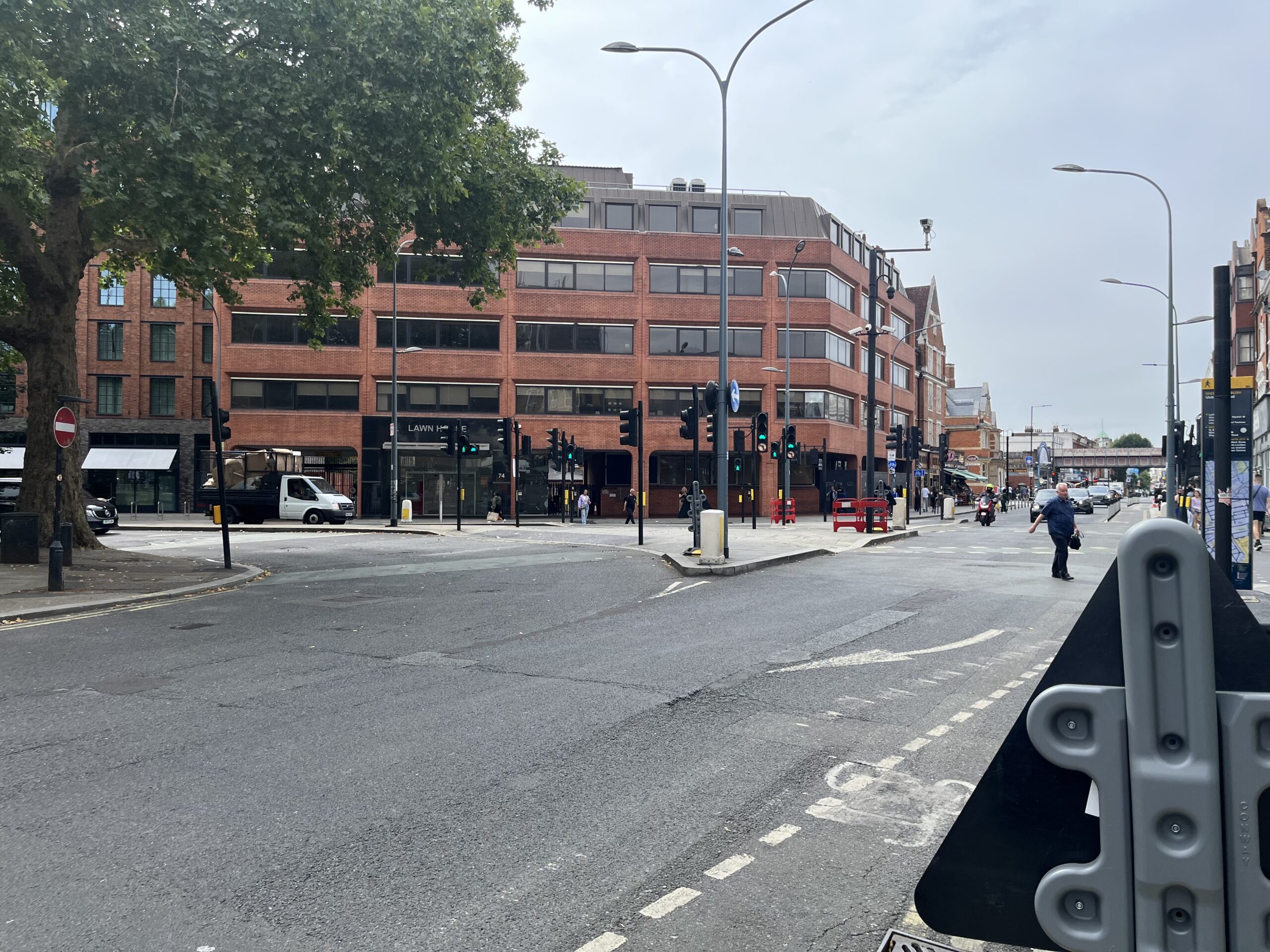
Lawn House – as existing
Continued
- Published: 6th August 2025

Royal Masonic Hospital Block A – showing originally proposed glass pavilions, now removed
This project finally received permission by unanimous vote after a long planning meeting on 30th July, but with some remaining concerns expressed by neighbours. A member of your committee attended to observe and note the proceedings. We’ve written about this project four times and have been working to help improve the scheme since the site sale over three years ago.
The issues were primarily around proposed design and building heights for the new 5-storey blocks E and F (given the conservation area/listed building location), adjacency issues for neighbours at both ends of the site, transport access, affordable housing provision, historic gardens, and importantly in this case, proposed additions to the Grade II* listed buildings, particularly glass pavilions originally proposed on block A (pictured above), and the liner-style balconies on blocks B and C which have adjacency issues with Ravenscourt Gardens neighbours.
Recent Changes
There have been two significant revisions since the original planning application in April 2024, which sought conversion to 140 flats, 65 care home places (discharging a medical covenant), 21 affordable, plus community use of block A (the main entrance).
In the first, last November, the glass pavilions were ushered off after our concerns, those of Historic England (really notable harm), the Historic Buildings Group, and the 20th Century Society were acknowledged, and an improved solution was found to the privacy / adjacency issues on the balconies, after the proposed heavy concrete planters were similarly dispatched. The screening issue has been addressed by glass inner balustrades, and a pleached tree boundary treatment, with separation distances discussed at some length by the planning committee, and shown to be greater than 18m in all but one case.

RMH Blocks E & F – from May 2023 revision
In the second earlier this year, replacement block E/F maximum heights were lowered, and made more uniform by removal of the roof plant, moving it below ground in the place formerly allocated for car parking, this now being a car-free development, satisfying LBHF planning policy and some traffic concerns mentioned by existing neighbours. Part of this change was brought about by welcome adoption of a Ground Source Heat Pump heating system, and solar PV on the roof. There were also refinements to the landscaping and planting, including relocation of a copper beech tree at the end of block C.
A review of comments made in our earlier articles shows that many of the issues raised by us, and others, have been addressed positively in the final design.
The planning committee accepted the officers’ assessment that the substantial public and heritage benefits of restoring the vacant listed building and opening it to the public outweighed the identified less than substantial harm, and that the impacts on neighbour’s amenity were acceptable. Support from Historic England was a significant factor in this decision, the hospital having been on the Buildings at Risk register.
Continued
- Published: 11th June 2025

Rivercourt LTN council information
In the six months since the temporary Rivercourt Road LTN was put in place, we’ve received messages nearly every week – vanishingly few positive – and it’s still regularly our most read article on the website. Messages fall into the following categories, with more than one correspondent questioning legality:
- Implementation problems:
- I’ve received a fine, I don’t know why.
- The signage / wording is poor – I had no idea I wasn’t supposed to go down there.
- I paid for a visitor by RingGo who still got fined.
- I witnessed someone reversing into the A4 – the ‘turning circle’ is dangerous – or – I witnessed an accident caused by someone slowing down/stopping to read the signs and being hit from behind, creating a multi-vehicle shunt – example images below.
- The LTN is damaging my business, I’m leaving the borough.

Rivercourt crash front

Rivercourt crash rear-end
The “local access only” wording and cacophony of messy signage is considered deceptive by many correspondents – this and many of the other are points were raised in our original article.
Anecdotal evidence suggests that when challenged on a PCN fine, the council may back down, rather than attend a tribunal, however there’s rather more to this story, when considered in the light of the recent High Court case.
JULY 2025 UPDATE Based on the council’s publicity, residents may have believed that they could allow visitors, quote: “Local residents can also easily get access for the visitors by using the RingGo app, which has proved widely successful in residential areas throughout the borough…” The words throughout the borough are misleading and only part of the story. In fact only residents in certain streets extremely close to Rivercourt Road can provide access for their visitors. LBHF now says (but doesn’t yet publicise the details): Cromwell Avenue, Weltje Road, Beavor Lane, Vencourt Place, Ravenscourt Park, (only some properties: from junction of King Street to the train bridge) and Ravenscourt Road (only part from junction of King Street to the train bridge). A number of residents have written to us, detailing problems they’ve had with the Ringo system which was supposed to have been upgraded five years ago to properly support LTN access, but still has senior moments. Caveat emptor.
The West Dulwich case
Last month, the legality of the way in which an LTN was implemented by Lambeth Council in West Dulwich was tested in the High Court, and found to be unlawful. It wasn’t the legalities of the LTN itself, but the poor way in which consultation was carried out, and the way in which the council failed to take due consideration of well researched and detailed evidence provided by local people in a 53-page submission.
Continued
- Published: 11th June 2025

Images from Design & Access statement for 2025/00389/FUL
We’re pleased to note that yesterday, LBHF and RBKC simultaneously approved the proposed pedestrian and cycle underpass underneath the Overground (Mildmay Line), linking the Imperial White City North Campus to North Kensington’s Latimer Road. Modelled on continental schemes by Dutch architects West 8 of Rotterdam, the D&A statement includes images from several similar schemes – reproduced here – including those seen in Amsterdam and Rotterdam. This begs the question – could TfL replicate this at the opposite end of what was once “The world’s shortest motorway” – the West Cross Route – just 1km south ?
The approved scheme is part of a Section 106 commitment made by Imperial as part of their scheme at the White City North Campus in 2013. We advertised and attended an exhibition of the proposals last September in Wood Lane, and it was approved by the councils at simultaneous planning meetings on 10th June.
The images speak for themselves, the only significant issue appearing to be how to keep pedestrians safe from any ‘turbocharged’ e-bikes that are likely to appear: the RBKC committee agreed to a 6 month safety review. Mopeds and other officially recognised motorbikes won’t be allowed, and CCTV is in the design to ensure that the council’s LET team and Imperial will be able to monitor transgressors. Affiliate St. Quintin and Woodlands Neighbourhood Forum has a longer report with more of the history of the scheme.
Holland Park Roundabout

HPR TfL proposal
Last year TfL presented a proposal for Holland Park Roundabout (HPR). It provides an additional cycleway, but removes a lane of Holland Park Avenue (HPA), routing bikes around the Thames Water Tower on the inside of the roundabout, and across the 3 lanes lanes of traffic, making it a maximum of 8 lanes wide, as shown, requiring additional junctions, and additional signals.
The roundabout currently provides cycle and pedestrian routes north and south: the relevance to this story is that the existing northern underpass, under the pedestrian surface crossing at the southern end of the West Cross Route, bears more than a passing resemblance the scheme just approved 1km north. It could provide a lower cost, very much simpler, safe and ready-made solution.


Those writing to us have expressed concerns over the likelihood of further delays to the many already congested buses at Shepherds Bush Green, and down HPA – seriously congested in rush hours – plus the scheme’s apparent unnecessary cost, complexity and added dangers. The proposal creates additional junctions where the 8 bus routes, numbered 31, 94, 148, 228, 49, C1, 295, and 316 cross to Shepherds Bush bus station / Westfield, through which it’s proposed to drive a bidirectional cycle lane. The well-established statistic is that 80% of accidents happen at junctions.
TfL also suggests there would be some local traffic displacement, which, with Shepherds Bush residents already significantly affected by Westfield, would present further problems. Independent traffic analysis using industry standard models – incorporating the loss of one lane on HPA – shows that the scheme would greatly increase congestion, supporting our correspondents’ concerns.

Telegraph HPR – click for/video
A video report in last weekend’s Telegraph shows that a number are significantly adding to their own risks by running the poorly timed lights at the bottom of HPA.
TfL suggests that HPR is high on their list of London’s most dangerous junctions – the main reason for the scheme. Local campaign group SOS dispute the accident figures by a large factor – TfL claim 54 accidents in the 3 years to May 2023, but SOS’s detailed analysis from public records only shows one slight accident involving a cyclist, and no pedestrian incidents at all – despite the above activity. TfL cast a wide net over the area including much of Shepherds Bush Green and the junctions close by to create their ‘HPR danger’ narrative. The London Cycling Campaign has campaigned in support of the proposal, but does not include the roundabout in it’s list of top 20 dangerous junctions.

Save our streets leaflet (click to view)
SOS are highlighting the dangers of the proposed additional junctions, their analysis of TfL’s own consultation data obtained under FOI, suggesting that only 12% of residents and 30% of cyclists support the scheme. Many currently eschew the existing infrastructure altogether (paths and crossings), and use the road – as is – as the video shows.
Continued
- Published: 27th May 2025

Empress State Building (+Earls Court 2)
[photo: Wikipedia]
Hammersmith has several tall buildings, the latest being 181 Talgarth road, but perhaps the most iconic is 1961’s Empress State (31 Storeys) next to Earls Court. There are more in the pipeline, particularly on our borders. Six years ago, we wrote about the increasing fashion for rather less iconic hi-rises, then referring to what we now call the Ziggurat (35 storeys), Centre House (32 storeys, now largely complete opposite TV Centre on Wood Lane), and the prospect of what was being planned at North Acton, in an “almost continuous string of high-rise developments from NW10 to W12”.
We’re not there – yet – but unknown at the time were the remaining details around Imperial White City and White City Living, 227 Wood Lane, Earls Court – now proposing to build upwards to 42 storeys – and a 29 storey tower, 100 Kensington starting to loom over Tesco at 100 West Cromwell Road next door, and of course along the way, 181 Talgarth road. Wandsworth recently rejected Terry Farrell’s 29-storey tower on the south side of Battersea Bridge, perhaps suggesting that the recent article by Sir Simon Jenkins has been read London was a city of streets; now it’s a city of towers
Michael Bach of the London Forum recently noted that according to the NLA annual tall buildings report, the pipeline for London’s tall buildings numbers nearly 600 – equivalent to a 20-year supply – based on the completion rate of the last 10 years.
The GLA, London Plan and Tall Buildings Report

Do tall buildings work?
Tall buildings have become the consistent hallmark of Mayoral Opportunity Areas since Ken Livingstone’s days, detailed in our recent Planning System article, more recently favoured by the student accommodation sector (PBSA), notably at North Acton, but also from White City to Nine Elms, and farther afield, remembering that Earls Court is also an opportunity area. This has led to the recent GLA investigation, and last month’s publication of their Tall Buildings Report. Far from extolling the virtues of tall buildings, important questions are now being asked about the cost (both rent/purchase, and long term, including to the environment), suitability for the people housed in them, particularly families, quality of construction, and of course whether they are actually addressing the ‘housing crisis’.
In the run up to the next London Plan due in 2026-7, the Mayor’s “Towards a New London Plan” document and consultation suggests that his dissatisfaction is that some boroughs haven’t clearly identified tall building locations, and may mandate new rules for tall building clusters, including a minimum height benchmark for small sites, with potentially lower maximum heights near the river. Any clarification would be welcome. While there’s a welcome proposal to reduce duplication with the NPPF and other policies, and sensitivities around Tall Buildings are recognised, there are a lot of options being tabled here, which might suggest a lack of confidence and/or strategic direction. The public consultation is open until 22 June.
The developer’s argument is often straightforward – it creates more housing on less land, and is more viable. One of the spanners in the works has been the requirement for two staircases post-Grenfell, reducing floor sizes, so putting yet more pressure on heights. There’s also the potential for an insidious side-effect of Mayoral the call-in process, regularly used to approve such designs often against local opposition, and councils (current examples being a 46 storey PBSA tower in Canary Wharf, and a 27 storey PBSA tower at Archway) – the typical step-and-repeat, so called spreadsheet architecture means that developers can easily stretch the tower upwards to meet the demand for a minimum 35% affordable, or until an agreed figure is reached, with almost no design effort at all. Then they can blame the Mayor.
Last year, the London Forum reported that London is “on course to have the most crowded skyline in Europe“, following a Policy Exchange report that says ‘mania’ for high rise development has damaged UK cities’ and that far from helping the housing crisis, ‘tall buildings have in fact “made it worse”’. In one memorable week, around half the stories in our Hammersmith Weekly email were about hi-rises, with recent stories around Westfield Living confirming many of the issues.
Whatever the truth of the claims and counter-claims, in the twenty years of London Plans, coincident with the drive upwards (that was supposed to address the problem), the housing situation has turned from a problem to a “crisis”, and some of the original towers are already being demolished for yet taller ones, before questioning whether they are part of the solution, or part of the problem.
Continued
- Published: 28th April 2025

Mogden sewage works [photo : eight2O]
With the recent boat races having brought with them the annual hand-wringing over river pollution, providing the Mayor with an opportunity to remind us of his 2024 pledge to make London’s rivers swimmable within 10 years, it seems an appropriate moment to review the status quo in this long running saga.
In addition to the annual boat race related news, there have been a number of stories in the wake of the recent Thames Water TV documentary and the related Tideway Tunnel or ‘Super Sewer’ completion, after more than a decade of construction. The programme revealed a team of people battling the odds to keep an overstretched system working, and not always winning. It must be disappointing for those working on the project to have so much of the news created by the things they were working for years to fix.
There’s the small matter of the automatic outfall monitors now mandated by OFWAT which, connected directly to Twitter, became an effective way to allow the public to beat the water companies with their opprobrium. It may be that there were plenty of spills before these monitors, but that nobody could put a number on them, and the increasing heavy rainfall episodes have clearly not helped.

Original Super Sewer plans
Notwithstanding the connection to the Super Sewer at Hammersmith under the watchful eye of our own Capability Brown, and at Fulham on Carnwath road, there have been quite a range of related stories that help illustrate the causes, effects and work being done – or not – to address them, here’s a roundup:
Continued
- Published: 10th March 2025


The Olympia project is approaching completion after over seven years of planning and construction, and has been holding ‘sneak peeks’ for locals to see in and around selected parts of the building in recent weeks. We were fortunate enough to join one of these tours. As has been fairly longstanding policy, no independent photos were allowed, but a set of Olympia’s own photos were provided instead. We saw many of the views shown here.
The scale of the whole development is immense as we’ve said before – remembering that we didn’t go anywhere near the existing (open) parts of the site – the main exhibition halls, areas such as the Pillar Hall, or the Maclise road car park – AKA Hyatt hotel and school, or indeed the Hotel being built above the Hammersmith Road frontage.
The most complete part of the building that is not yet open is the music venue, billed as The Olympia Music Hall , cleaned and ready for imminent fit-out by the tenant AEG – the same organisation that runs the existing O2 Arena in Greenwich. The capacity is in excess of 4000, slightly more than the Hammersmith Apollo, but the number here is an ‘all standing’ one with a relatively small gallery and VIP area – shown with a couple of people standing in it in the photo looking towards the stage. The equivalent ‘standing’ for the Apollo is 5300.
By contrast, the 1500-capacity theatre is the least well advanced of all the areas, though right next to the music venue, simply because it was started last in the programme, and had to be built entirely from the ground up. Photos show the underside of the raked seating structure (in white), and the size and substantial height of the backstage area can clearly be seen. In fact so cavernous is the backstage area, that they unusually plan to build a couple of floors of office/theatre administration on top of the fly-tower. There’s an orchestra pit provided for this conventional proscenium-style auditorium, allowing for musicals. When the shell/core construction is complete, this will be fitted out by well-known CharcoalBlue consultants, for the selected operator Trafalgar Entertainment.
Interlinking the back of these venues, and the offices / conference centre is a substantial open elevated walkway, the size of a road, which sits above and between the two existing exhibition halls, and leads to the glass canopy restaurants (pictured), and then eventually to the large stairs and escalators down to Olympia Way and the railway. There was some discussion about a huge video wall – or rather video ceiling – along this walkway, which given the contrast between the open Eastern end, and the somewhat subterranean feel to the other end, will be welcome. The glass canopy area is open, and the part-covered roofs of the restaurants are also planned to be used for further hospitality, though a number of us, on a cold February morning tour, felt that here, optimism had triumphed over the realities of the British weather.

Olympia Sneak Peek
We had the opportunity to see an office floorplate (pictured above), which was as unremarkable as office floorplates typically are, apart from it’s size and the vista from it’s windows and balcony, on which were also able to stand. There’s a excellent uninterrupted view all the way across to Crystal Palace and the South Downs, via Earls Court’s Empress State Building from these private (for the office’s use) balconies, which will surely be a big pull factor.
Continued
- Published: 16th February 2025

Andy Slaughter MP at HACAN AGM 2025
We attended the HACAN AGM at the Irish Cultural Centre last week where our MP Andy Slaughter was guest speaker. Those attending our 2023 AGM will also recall mention of the third runway in his speech, but only in passing. It has of course never left Heathrow’s agenda, though it must have come as a surprise that this government, with its green ambitions, would put Heathrow expansion on its to-do list quite so quickly.
Andy was bold enough to suggest that Heathrow expansion may have been swept up as part of an overall positive economic growth agenda, and might be as easily dropped should it fail the government’s tests for noise, air quality, carbon and economics. That’s the straightforward narrative, but not the whole story. There may be rather more to it, as HACAN clearly outlined.
There was much incredulity in the audience as to how the various tests might be, or have now been met, with or without the magic ingredient of 2030’s proposed 10% Sustainable Aviation Fuel (SAF) rising to 20% in 2040, and indeed Andy suggested that the proof will lie in the proposals that Heathrow bring forward later this year. It’s no secret that he has long been an objector. together with many civic and other societies blighted under the flight path, and potential paths, such as ourselves. As we’ve reported, the chair of parliament’s Transport Committee is now Ruth Cadbury MP, another noted local opponent. Her committee is examining this proposal.
Continued

News Topics
Our Diary
-
Committee meeting
📆 Mon 27th Apr | 18:00 - 20:00
-
Committee meeting
📆 Mon 1st Jun | 18:00 - 20:00
-
Committee meeting
📆 Mon 13th Jul | 18:00 - 20:00
Recent News


Local and Affiliate News
One news item from each selected source – more on our Local and Affiliate news page. Subscribe to our weekly highlights

Most Popular Articles This Week


 ©2026, The Hammersmith Society | Privacy | Contact | Join | @ Subscribe | ⓘ
Campaigning for over sixty years